
Hitchcock County Court Records After Arrest
After a Hitchcock County arrest, the jail booking record and the court record are not the same file. The Hitchcock County Sheriff's Office is the local source for custody, booking, bond, and hold questions. The court record starts when a criminal case is filed or entered with the court. That may happen after the prosecutor reviews the arrest report, selects the charges that can be supported, and files a complaint or other charging document.
Nebraska counties use a County Attorney rather than a District Attorney title. The Hitchcock County Attorney page identifies D. Eugene Garner as county attorney and describes the office's role in criminal cases involving the state or county. That office decides what to file after many local arrests. Booking details remain a jail question, so current custody belongs with Hitchcock County jail inmate records, while booking photos and mugshot access belong with Hitchcock County jail mugshots. Court records after a jail arrest focus on filed charges, hearings, docket activity, and the final disposition.
The local court path depends on the charge. The Hitchcock County Court handles misdemeanors, traffic and municipal ordinance cases, and preliminary hearings in felony cases. Felony matters can then proceed through district court. The case may show different charge text from the booking entry because a booking charge is an intake label, while a filed charge is the prosecutor's formal court allegation.
Find Hitchcock County Court Records
The official online route for Nebraska county and district court cases is JUSTICE one-time case search. It covers criminal, civil, traffic, juvenile, and probate cases in Nebraska's county and district courts. For Hitchcock County court records after an arrest, this system is useful after the case is entered. The entry page notes that there can be a 24-hour lag between a new case entry and search visibility, so a very recent arrest may still require a call to the sheriff or the court clerk.
The Nebraska Judicial Branch case-information materials also describe courthouse public-terminal access and case-information services. Free access may be available at courthouse kiosks or law libraries. JUSTICE is not a live jail roster, and it is not a mugshot source. It is the court case lookup for filed charges, parties, costs, payments, register-of-actions entries, and some uploaded document images.
- Start with the person's full name. A name search uses the party name, not a witness name.
- Use JUSTICE only after accepting the portal terms and beginning a one-time search.
- Review case matches carefully because results may include more than one court or case type.
- Open the criminal case and read the charge list, hearings, bond entries, and current status.
- If no case appears, contact the sheriff for current custody or the court clerk for entry timing.
The JUSTICE search entry page is shown in the manifest screenshot below.
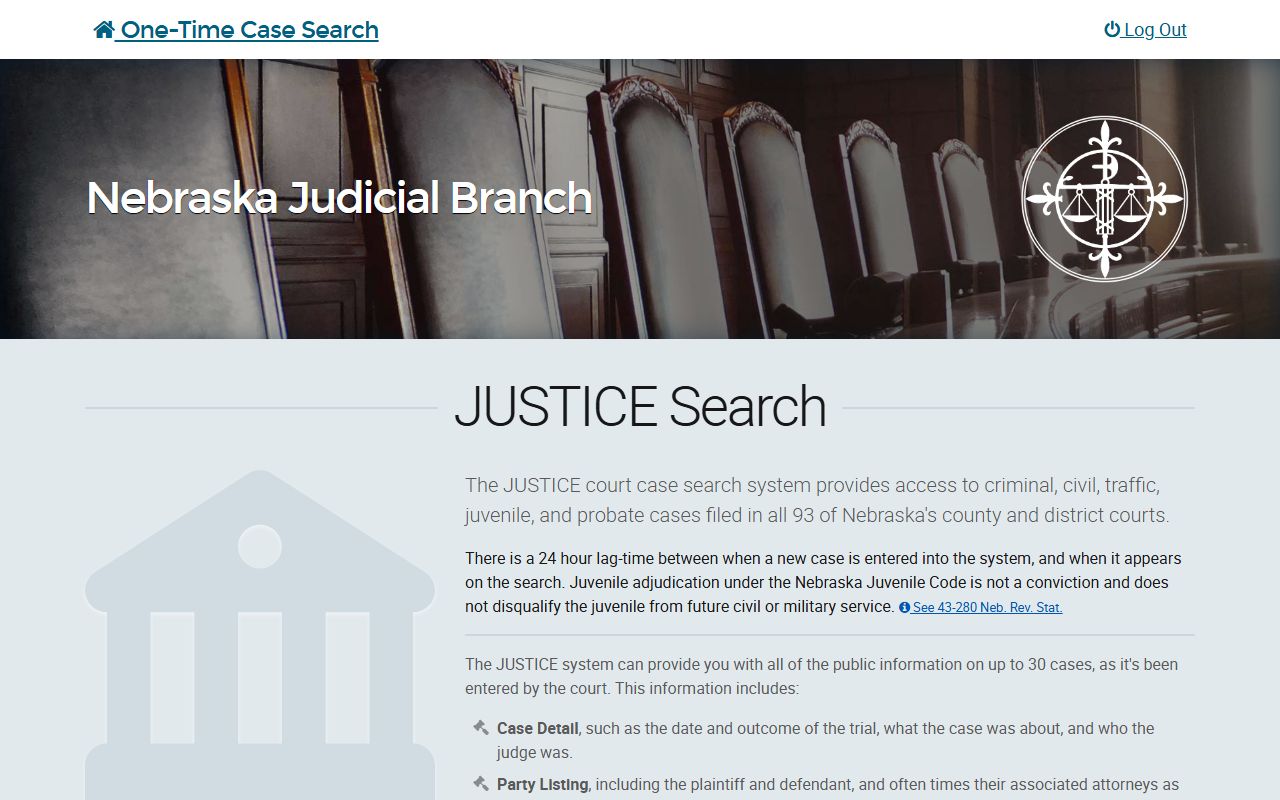
The screenshot matters because the portal is a paid case-search workflow, not a county jail search box. It should be used when the arrest has become a court case.
Hitchcock Court Case Search Fields
JUSTICE has a small entry workflow before the case search begins. The research did not capture a full defendant-profile screen, but it did identify the access fields and the most important search limits. The portal can return public information on up to 30 cases and keeps access to purchased results open for three calendar days. Searches with no matches still require payment.
| Field Label | Type | Required | Notes |
|---|---|---|---|
| Terms and Conditions | Checkbox | Yes | Must be accepted before the one-time search begins. |
| Begin Search | Button | n/a | Starts the JUSTICE search workflow. |
| Party name search | Form | Yes for name search | Use the defendant or party name, not a witness name. |
| Additional criteria | Form | Optional | Not recommended unless a name-only search returns more than 30 cases. |
Court information may include case detail, trial date and outcome, subject of the case, judge, party listing, plaintiff or defendant details, attorneys in many cases, court costs, payments, register of actions, and images of documents filed or uploaded after April 16, 2008.
Hitchcock County Courts After Arrest
Two local court offices can matter after a jail arrest. The Nebraska Judicial Branch Hitchcock County Court listing identifies the county court as part of the 11th Judicial District and lists clerk magistrate Linda K. Smith. The Hitchcock District Court listing identifies the district court clerk as Margaret Pollmann. Both offices use a Trenton mailing address at PO Box 248, and both are tied to the courthouse system rather than the sheriff's jail function.
The county court is the expected place to see misdemeanor cases, traffic and municipal ordinance cases, and felony preliminary-hearing activity. District court is where felony cases proceed after the proper step or filing. A person can be in the Hitchcock County Jail while one court handles an early appearance and a later court handles the main felony file. That is why a search for court records after an arrest may need both the county court and district court listings.
The Hitchcock County Court listing is captured below as a source for local court access.
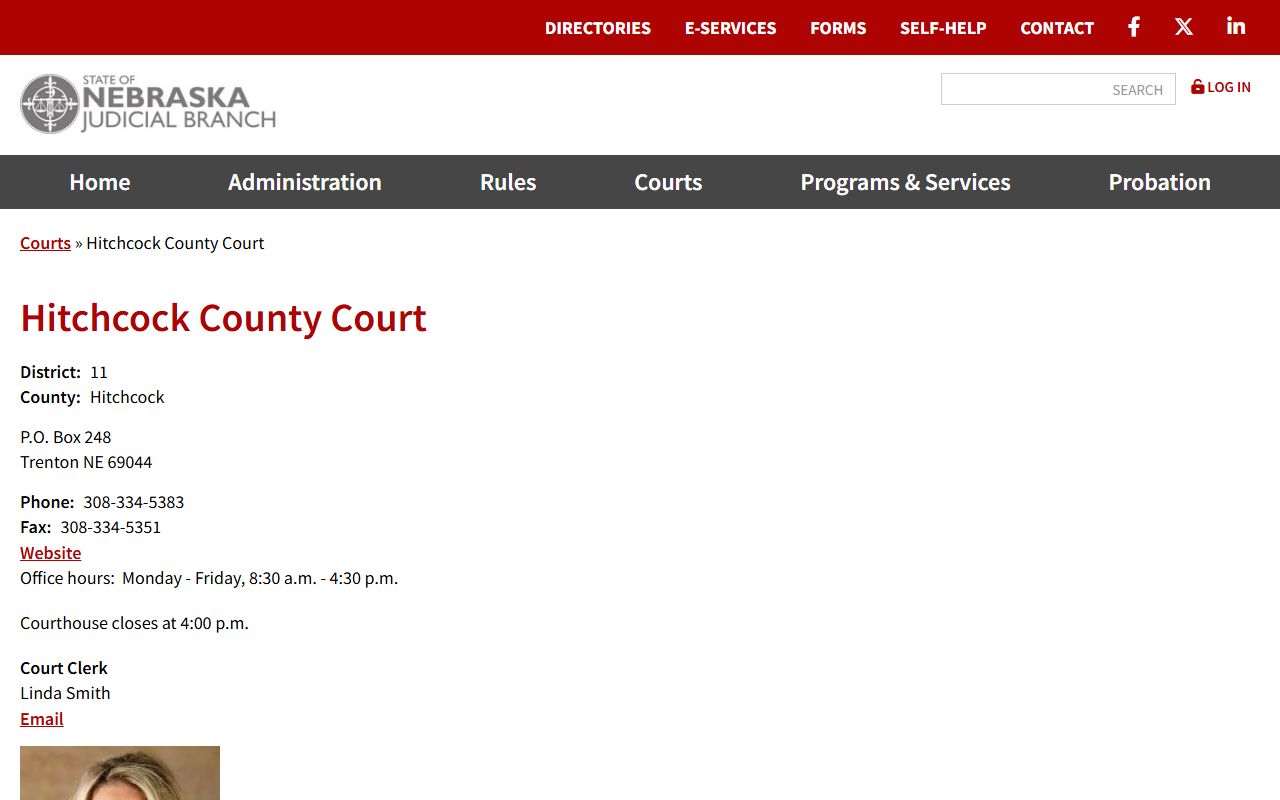
This court source helps separate court case records from jail custody records, which are maintained through the sheriff's office.
Charges Filed After Arrest
The charging paper is the point where a jail arrest becomes a court accusation. In Nebraska practice, a complaint can start many criminal cases. An information is a prosecutor-filed formal charge, often associated with district court felony practice. An indictment is a grand-jury charging document. Hitchcock County research did not locate a county-specific public packet explaining every filing path, so the safest record use is to read the actual case docket and document image when it is public.
| Document | Who Uses It | What It Means |
|---|---|---|
| Complaint | Prosecutor or law enforcement process | Often starts a criminal case after the arrest and sets out the alleged offense. |
| Information | County Attorney | A prosecutor-filed formal charge, commonly used in felony case progression. |
| Indictment | Grand jury | A formal accusation returned by a grand jury in the cases where that route is used. |
A filed charge can be broader, narrower, or different from a booking charge. A booking charge may reflect the arresting officer's initial label. The court charge reflects what the prosecutor placed before the court. That distinction is central to court records after a jail arrest.
Hitchcock Arrest Charge Status
Charge status can change as the case moves through court. A charge may be pending at first appearance, amended after review, reduced as part of a plea, dismissed by the prosecutor or court, or resolved by conviction, acquittal, deferral, or set-aside. The register of actions is the best place to follow the change because it lists court events in date order.
| Status | Plain-English Meaning |
|---|---|
| Pending | The charge has been filed and remains unresolved. |
| Amended | The filed charge text, level, or count has been changed by court action or prosecutor filing. |
| Reduced | The charge has been lowered to a less serious offense or level. |
| Dismissed | The charge ended without a conviction on that count. |
| Acquitted | The person was found not guilty of the charge. |
| Convicted | The charge ended in a guilty plea or finding of guilt. |
Note: A charge status is not the same as custody status. A person may be released while charges remain pending.
Bond Records After Arrest
Bond information after a Hitchcock County arrest may appear in the court record after a judge sets release terms, but the practical first check is still the sheriff. The research found no official Hitchcock County online bond-payment procedure, jail lobby rule, or payment-method page. A caller should ask whether bond has been set, whether payment belongs with the sheriff or the court clerk, and whether another hold prevents release.
| Bond Type | How It Works |
|---|---|
| Cash bond | Money is posted to secure appearance, with final handling controlled by the court record. |
| Surety bond | A third-party surety may post bond when allowed by the court. |
| Recognizance | Release is based on a promise to appear and follow court conditions. |
| Conditional release | The person is released with conduct, contact, reporting, or other court terms. |
| No-bond hold | Ordinary payment will not release the person until the hold is resolved. |
Neb. Rev. Stat. 29-901 addresses recognizances in criminal cases. Neb. Rev. Stat. 29-908 covers failure to appear after release on bail, recognizance, or conditional release.
Warrants and Court Records
No official Hitchcock County active warrant list or warrant search portal was located in the county sources. A warrant arrest usually creates a jail booking, but the county does not publish an official online booking roster. Once a case is filed or updated, warrant activity may appear in JUSTICE or on a courthouse terminal if the entry is public. Bench warrants commonly relate to failure to appear or violation of a court order, while arrest warrants authorize arrest on a criminal allegation.
For local warrant and custody questions, use the Hitchcock County Sheriff's Office at (308) 334-5444. For misdemeanor, traffic, and county-court bench-warrant questions, use Hitchcock County Court. For felony case warrants, use district court records. Federal warrants are different. The U.S. Marshals District of Nebraska handles federal fugitive matters and is not a county jail roster.
Charges Versus Convictions
An arrest and charge do not prove guilt. Court records after an arrest show allegations first, then later events and outcomes. The distinction matters for employers, housing, licensing, immigration, and personal record review. For official statewide criminal history, the Nebraska State Patrol criminal history request page describes the public request route and fee information.
| Point | Charge | Conviction |
|---|---|---|
| Case stage | An accusation filed after arrest review. | A final guilty finding or plea on a count. |
| Proof level | Starts from probable cause and pleadings. | Requires proof or plea under the court process. |
| Record use | Needs context because it may be pending, dismissed, or amended. | Shows an adjudicated outcome, subject to later relief if any. |
Sealed and Removed Records
Nebraska public-records law starts with access, but not every arrest-linked record stays public. Neb. Rev. Stat. 84-712 gives interested persons a route to examine public records and obtain copies subject to fees. Neb. Rev. Stat. 84-712.05 lists records that may be withheld. For criminal history, Neb. Rev. Stat. 29-3523 addresses when arrest, citation, or referral information is removed from the public record after no charges, dismissal, acquittal, or other listed outcomes.
| Record Limit | Meaning | Practical Effect |
|---|---|---|
| Sealed | Public access is blocked or limited by law or court order. | The public may not see the record, but certain agencies may retain access. |
| Removed from public record | Criminal history dissemination is restricted under qualifying Nebraska law. | Public RAP history may exclude the event when statutory conditions are met. |
| Expunged | A broader clearing term often used by the public. | Use the specific Nebraska statute and court order rather than assuming total erasure. |
Juvenile matters, active investigations, sealed documents, some dismissed matters, and safety-sensitive records can be restricted. When a court record cannot be found online, the absence of a result is not proof that no arrest occurred.
State Federal ICE Records
Court records after a Hitchcock County arrest should not be confused with custody databases. The NDCS Incarceration Records search is for sentenced state prisoners, not new county jail bookings. The BOP inmate locator is for sentenced federal prisoners. ICE custody is searched through ICE ODLS, and the official ICE McCook Detention Center page is relevant only when immigration custody is involved. NEVCAP, the Nebraska Victims of Crime Alert Portal, is a notification route rather than a court docket.
Important: These custody tools do not replace JUSTICE or courthouse records for filed Hitchcock County court charges after an arrest.